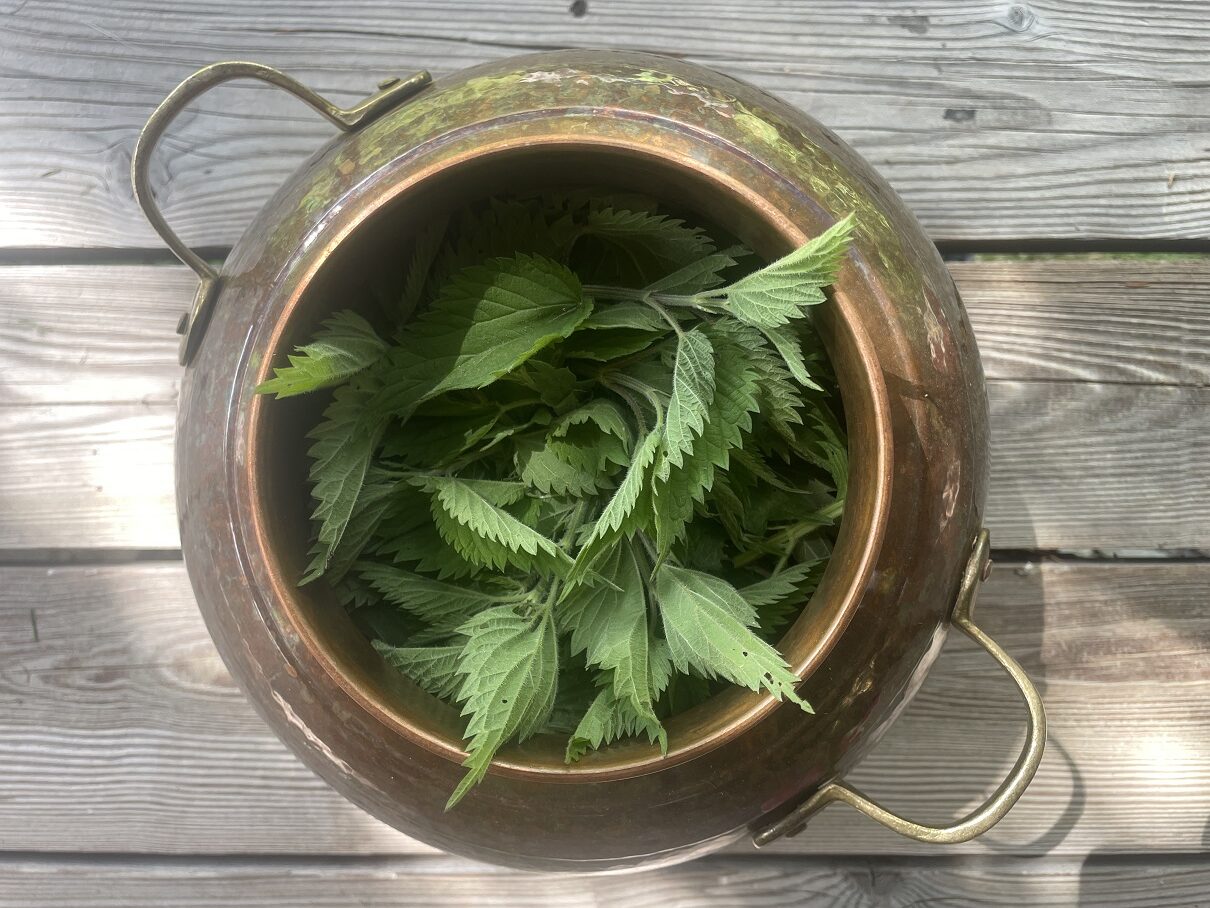

Stinging nettle (Urtica dioica L.) is one of the most widely used medicinal and cosmetic herbs in Europe and is well known around the world. Traditionally valued as both food and medicine, nettle is rich in biologically active compounds and minerals.
The herb
Active constituents of nettle leaves include flavonoids (quercetin, kaempferol), chlorophyll, sterols (beta‑sitosterol), vitamins (C, B‑group, K1), organic acids (formic, acetic, butyric), minerals such as iron, magnesium, potassium, sodium and silica, and plant fibre .
Being nutrient‑rich, fresh nettle is my favourite ingredient for spring smoothies to help restore the body. No – it doesn’t sting your tongue or mouth; the blender takes care of that. Dried nettles also remain a useful ingredient for soups, teas or smoothies later in the season.
One extraordinary folk remedy is widespread in Europe – topical application of fresh nettle, by stinging the skin around inflamed joints. This can help relieve pain and stiffness.
Although I harvest nettles wearing protective gloves, I don’t mind getting a few stings in the process.
Forms of preparation: tinctures, teas, decoctions and hydrolates.
Nettle preparations are traditionally used for skin and hair, urinary, digestive, and circulatory systems. It supports the whole body.
Let’s explore two of the most important preparations for the distiller – the hydrolate and the decoction.
The hydrolate
Although nettle is not an essential oil-bearing plant, it is distilled for hydrolate, which retains a characteristic aroma: fresh, green, herbal and slightly earthy.
Hydrolates (hydrosols) contain volatile aromatic compounds but not the minerals, tannins or vitamins.
Aroma profile and volatile compounds
Krajewska and Mietlińska (2022) identified more than 80 volatile compounds in industrial nettle hydrolate. Oxygenated volatiles – especially alcohols – dominate. Key compounds and their reported contributions include:
| Compound | % of total volatile fraction | Aroma impact and activities |
| (Z)-hex-3-en-1-ol and (E)-hex-3-en-1-ol | 33,6 | contribute to green, grassy, leafy, and fresh plant-like aromas |
| Carvacrol | 10,5
|
antimicrobial, antioxidant, and anti-inflammatory activities |
| α-Cadinol | 4,7 | antifungal and antimicrobial activities |
| Caryophyllene oxide | 3,1 | anti-inflammatory, antifungal, antioxidant, and antimicrobial activities. |
| Borneol | 1,1 | anti-inflammatory and analgesic activities |
| α-Terpineol | 0,9 | sweet, floral, lilac-like aroma with woody nuances; exhibits antibacterial and antioxidant activities. |
Other notable constituents reported are p‑cymen‑9‑ol, 8‑hydroxyneomenthol, spathulenol and τ‑muurolol — all oxygenated terpenoids associated with antimicrobial, antioxidant and/or anti‑inflammatory effects.
The Polish study suggests that the relatively high proportion of alcohols may improve the microbiological stability of nettle hydrolate.
Potential trace non‑volatiles
In another study, Jakubczyk et al. (2021) researched several plant hydrolats and reported that they contain trace flavonoids (6-10 mg/L) and polyphenols (9-25 mg/L).
It is reasonable to assume most hydrolates include small amounts of flavonoids and polyphenols, contributing to antioxidant and anti‑inflammatory properties.
Uses of nettle hydrolate
Topical:
- Tonic scalp mists or rinses for shinier hair – all hair colours; oily hair
- As an ingredient of hair conditioner
- Facial toners for irritated skin
- Other aromatherapy products
Internal: L. and Sh. Price indicate nettle hydrolate is choleretic – it stimulates the liver to increase bile production and secretion. By increasing bile volume and flow, choleretics aid fat digestion, absorption of fat‑soluble vitamins and elimination of certain toxins via the digestive tract.
Nettle hydrolate may therefore be consumed as a mild digestive aid and liver support.
The decoction: a valuable co-product of hydro-distillation
During hydro‑distillation (when plant material is immersed in the pot), distillers also obtain a strong plant decoction. Unlike hydrolates, decoctions contain mainly non‑volatile compounds: minerals, tannins, flavonoids and some water‑soluble vitamins.
It would be a shame to simply discard it!
Topical uses:
- Scalp rinses for hair strengthening (valued for mineral and tannin content; best for dark hair)
- Compresses, skin washes for irritated skin.
- Herbal bath preparations
Plant fertiliser: Nettle is nutrient‑rich and commonly used as a fertiliser. Dilute to 1 part decoction to 5–10 parts water to nourish your plants.
Natural fabric dye: Nettles have traditionally been used to dye fabrics and yarn. Consider dyeing textiles in the leftover decoction to create distinctive packaging for your product or a wearable garment for yourself.
Find inspiration and learn how to use leftover botanical decoctions as ready-made textile dyes (covering suitable textiles, plant-to-fabric ratios, dyeing times, and expected colours) in my online lecture Dyeing in Decoction: Natural Colours from Copper Alembic Still.
Nettle hydrolate distillation parameters
The earlier referenced study analysed hydrolate composition across fractions collected during steam distillation of fresh nettle. A key finding was that hydrolate quality changes markedly during distillation.
The volatile content:
- measured 71.2 mg/L in the first fraction,
- peaked at 128.0 mg/L in the third fraction,
- declined to 6.2 mg /L in the final fractions.
The authors proposed an optimal production ratio of approximately 0.74 L hydrolate from 1 kg of fresh nettle herb.
The researchers point out that producing larger volumes of nettle hydrolosol from the same plant material will significantly dilute volatile compounds.
Practical notes from my distillation
I trialled the 0.74 L hydrolate from 1 kg of fresh nettle ratio in my recent nettle distillation. Based on aroma and taste sampling, the distillation could have continued, but I stopped intentionally. After opening the alembic, I could still detect a weak nettle aroma, further indicating the plant was not fully exhausted.
My practical advice: rely on your smell and taste to decide when to stop the distillation. In my experience, the fresh nettle to hydrolate ratio often sits closer to 0.9:1 (hydrolate to fresh nettle).
What the cited research shows clearly is that nettle hydrolate shifts rapidly from highly aromatic to weak as distillation proceeds. Therefore, monitor taste and aroma closely when the 1:0.7 ratio is reached and be prepared to stop quickly to avoid excessive dilution.
References
- Krajewska, A., & Mietlińska, K. (2022). Determining the parameters of the stinging nettle (Urtica dioica L.) hydrolate distillation process. Molecules, 27(12), 3912. https://doi.org/10.3390/molecules27123912
- Hoffmann, D. (2003). Medical herbalism: The science and practice of herbal medicine. Healing Arts Press.
- Price, L., & Price, S. (2004). Understanding hydrolats: The specific hydrosols for aromatherapy: A guide for health professionals. Churchill Livingstone.
- Ragažinskienė, R., Rimkienė, S., & Sasnauskas, V. (2005). Vaistinių augalų enciklopedija. Kaunas: Lututė.
- Easley T., Horne S. The modern herbal dispensatory. A medicine-making guide. North Atlantic Books.
- Jakubczyk, K., Janda‑Milczarek, K., & Tuchowska, A. (2021). Plant hydrolates – Antioxidant properties, chemical composition and potential applications. Biomedicine & Pharmacotherapy, 142, Article 112033. https://doi.org/10.1016/j.biopha.2021.112033